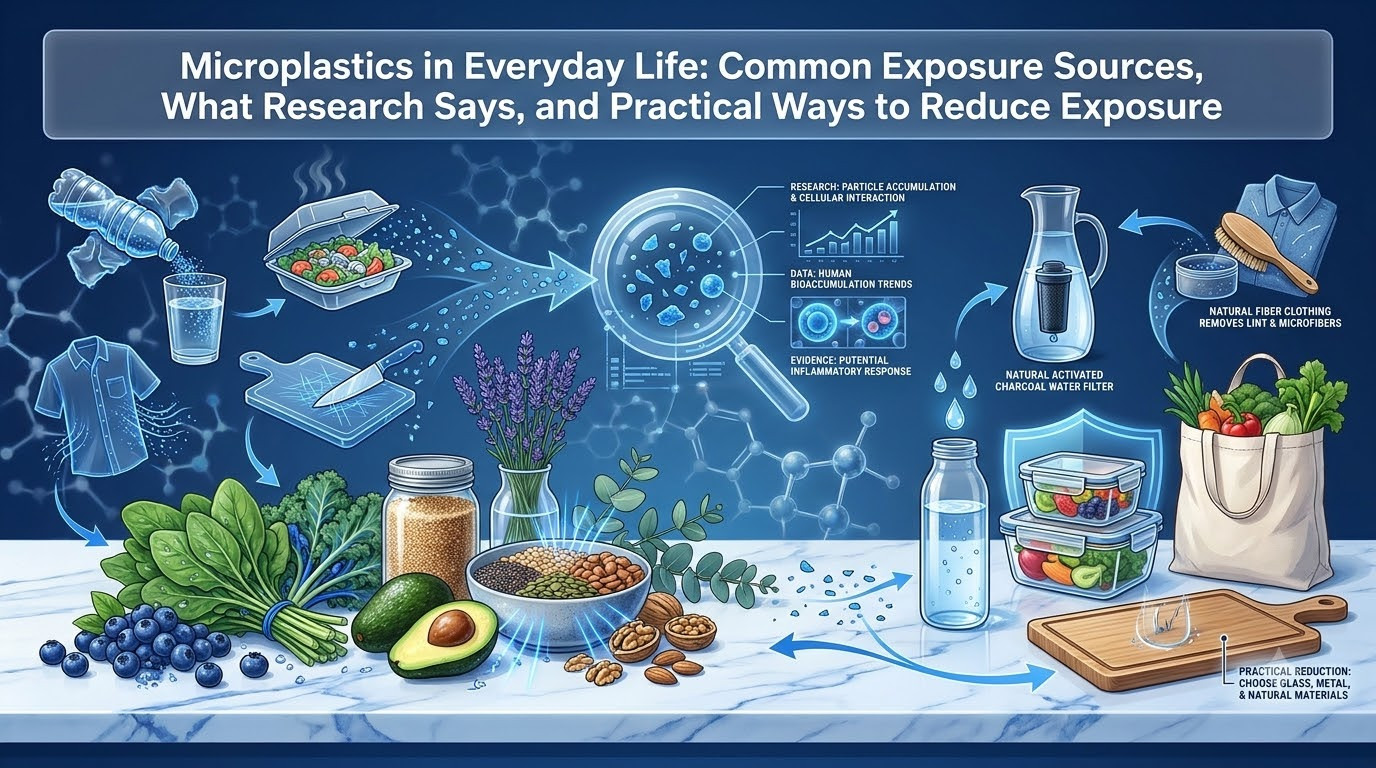
Plastic is part of everyday life: it appears in food packaging, water containers, household products, clothing fibres and many items we use without thinking. As larger plastic materials wear down, they can release tiny particles known as microplastics. Researchers have detected these particles in a range of environmental samples, foods and beverages, and human biological samples. That raises important questions about exposure and health—but it does not mean that every detected particle is proven to cause disease.
This guide explains common exposure pathways, what current research can and cannot establish, and sensible ways to reduce avoidable contact. The goal is not to eliminate every trace of plastic from daily life. It is to understand the evidence, make proportionate choices and avoid spending money on products or tests that promise more certainty than science can currently provide.
- 1. What Are Microplastics and Nanoplastics?
- 2. Where Everyday Exposure Can Occur
- 3. Food, Food Packaging and Drinking Water
- 4. Air, Dust, Clothing and Household Life
- 5. What Does Current Research Say About Human Health?
- 6. How to Read Microplastics Headlines Without Panic
- 7. Practical Ways to Reduce Avoidable Exposure
- 8. Common Mistakes, Safety and Unproven Detox Claims
- 9. Myth vs. Fact and a Practical Action Plan
- 10. Conclusion and Frequently Asked Questions
1. What Are Microplastics and Nanoplastics?
Microplastics are generally described as plastic particles smaller than five millimetres. They may be fragments, fibres, films, beads or irregular pieces. Some are manufactured at small sizes for particular industrial uses; others form when larger plastic items break down through sunlight, weathering, abrasion and other environmental processes.
Nanoplastics are smaller particles, often discussed at scales below one micrometre, although terminology and size boundaries are not completely uniform across studies. These particles can be particularly difficult to detect and characterise reliably. A method that identifies larger particles may not be suitable for detecting the smallest ones.
Why particle size matters
Particle size, shape, polymer type, surface characteristics and the chemicals associated with a particle can all affect how it behaves. Laboratory experiments suggest that some particles can interact with cells under particular conditions. However, laboratory findings do not automatically establish what happens at the levels people experience in ordinary life.
Researchers also need to distinguish plastic particles from other tiny materials. Sample collection, laboratory equipment, clothing fibres, airborne contamination and inconsistent measurement methods can affect results. Reliable studies therefore require careful controls and clearly described methods.
The central point is straightforward: microplastics are a real environmental contamination issue, but the health significance of a particular exposure depends on what particles are present, how much reaches a person, how the body handles them and what outcomes have been reliably measured.
2. Where Can Everyday Exposure Occur?
People can encounter microplastics through several routes. Food and beverages may contain particles originating from environmental contamination or parts of the food-production chain. Indoor and outdoor air can carry airborne fibres and fragments. Household dust can also contain particles shed from textiles and other materials.
| Possible Route | Everyday Examples | What to Keep in Mind |
|---|---|---|
| Food | Seafood, salt, produce and other foods sampled in research | Reported levels vary by food, sampling and analytical method. |
| Drinking Water | Tap water and bottled water | Results differ across water sources and studies; one result cannot represent every supply. |
| Indoor Air and Dust | Fibres from textiles and particles tracked indoors | Ventilation and cleaning can improve general indoor cleanliness; explore our protocols on Indoor Air Quality at Home. |
| Consumer Materials | Plastic items that experience wear or heat | Particle release depends on material and conditions; not every plastic product presents the same exposure. |
These pathways do not contribute equally to every person’s exposure. Work environment, housing, diet, water source, product use and local conditions can change what someone encounters. Scientists are still improving methods for estimating total exposure over time.
It is also important to separate environmental presence from individual health risk. Finding a particle in an environmental sample demonstrates contamination of that sample. It does not, by itself, establish the dose absorbed by a person or show that the exposure will cause harm.
3. Food, Food Packaging and Drinking Water
Microplastics have been reported in a variety of foods and beverages, including seafood, salt, honey, vegetables and drinking water. The European Food Safety Authority describes the presence of micro- and nanoplastics across environmental and food systems while highlighting important gaps in knowledge about dietary exposure and potential health effects.
Food contamination may occur at several stages, including production, processing, transport, preparation and storage. But tracing the source is not always straightforward. A particle found in a food sample might have come from the environment, processing equipment, packaging, handling or contamination during sample collection. Good research needs to account for these possibilities.
Tap water versus bottled water
It is not accurate to say that all bottled water is more contaminated than all tap water, or that all tap water is free of particles. Studies have reported particles in both. Results depend on the source, treatment, container, sampling procedures and detection methods. A single headline or test result cannot determine the best choice for every household.
For drinking-water decisions, prioritise the safety of the local supply. If your municipal authority issues a water-quality advisory, follow that advice. A properly maintained filter certified for the contaminant you need to reduce may help with certain water-quality problems, but do not assume a standard filter removes all micro- and nanoplastics. Check the product’s verified performance claims and maintenance requirements.
Using plastic containers safely
Do not assume that every plastic container releases the same number or type of particles. Material composition, wear, food type and temperature may influence migration or particle release. Follow the manufacturer’s instructions, especially for microwave use, hot foods and dishwasher safety. If a container is cracked, badly scratched, warped or not designed for the intended use, replacing it is a sensible general food-storage precaution.
Where practical, glass or stainless-steel containers can be convenient alternatives for some uses. They are not a guarantee of zero exposure, and there is no need to discard every intact plastic item immediately. For broader dietary storage and prep advice, consult our Practical Evening Nutrition & Healthy Eating guide.
4. Air, Dust, Clothing and Household Life
Indoor environments contain a mixture of dust, fibres and particles from many sources. Synthetic textiles can shed fibres during use and laundering, while outdoor air can carry particles from traffic, industrial activity, construction and the wider environment. Microplastics may be part of this mixture, but not every fibre seen in dust is necessarily plastic.
Researchers study inhalation and accidental ingestion of dust as possible exposure pathways. The amount a person encounters depends on the environment and activities involved. Current methods do not allow every household to calculate a precise daily microplastic dose simply by looking at its dust or clothing.
Reasonable household habits
- Clean regularly: Damp dusting and appropriate vacuuming can reduce household dust generally. The specific reduction in microplastic exposure varies and should not be overstated.
- Ventilate when appropriate: Use safe, practical ventilation based on outdoor air quality, weather and household needs.
- Maintain textiles: Follow garment-care instructions and avoid unnecessary high-wear washing. A laundry filter designed to capture fibres may reduce some releases into wastewater, but performance differs by product.
- Reduce avoidable waste: Reuse suitable items and dispose of damaged products responsibly rather than treating all plastic as an immediate personal health emergency.
5. What Does Current Research Say About Human Health?
Scientists have reported micro- and nanoplastics in some human biological samples, and research is investigating possible interactions with tissues and biological processes. A systematic review published in 2026 examined human in-vivo evidence and described associations reported in cardiovascular, reproductive, gastrointestinal and respiratory research. The authors also noted limitations, including differences between methods, exposure-measurement problems and risks of bias.
Those limitations matter. An association means two findings appear together in a study; it does not prove that one caused the other. People are exposed to many environmental and lifestyle factors at the same time. A study may not be able to separate the possible contribution of plastic particles from other factors that affect health.
What scientists are investigating
Research areas include inflammation, oxidative stress, interactions with cells, the movement of particles through the body and the possible effects of chemicals associated with plastics. Some findings come from cell experiments or animal studies, which can help identify questions for future research. They cannot be translated directly into a predicted disease risk for an individual person.
The US Food and Drug Administration states that current scientific evidence does not demonstrate that the levels of micro- and nanoplastics detected in foods pose a risk to human health. That is not proof that every possible exposure is harmless. It means the available evidence is not currently sufficient to demonstrate the claimed risk at those levels. Supporting systemic cellular resilience is covered in our Clinical Nutrition Master Guide.
6. How to Read Microplastics Headlines Without Panic
News stories may describe a study as proof that microplastics cause a disease. Before accepting that conclusion, check what the researchers actually measured. Was the study performed in humans, animals or isolated cells? Did it measure exposure directly, or infer it? Did it examine disease outcomes or only a laboratory marker? Was the research observational or experimental?
Five useful questions
- What kind of study was it? A laboratory experiment, an animal study and a human cohort study answer different questions.
- How were particles measured? Reliable identification and contamination controls are essential for tiny particles.
- Was the sample size adequate? A small study may be useful but can produce imprecise estimates.
- Could other factors explain the finding? Confounding variables can make an association appear stronger or more direct than it is.
- Do independent studies agree? Repeated results from well-designed studies are more informative than a single dramatic headline.
It is equally important to distinguish hazard from risk. A hazard is something that could cause harm under some circumstances. Risk depends on the real-world conditions of exposure, including dose and duration. Identifying a potential hazard is a reason for further research, not automatic proof of a particular level of risk in everyday life. For managing stress related to environmental headlines, review our guide on Nervous System Regulation in 2026.
7. Practical Ways to Reduce Avoidable Exposure
No practical routine can guarantee zero exposure. A sensible plan focuses on changes that are affordable, safe and useful without disrupting nutrition, hydration or daily life.
- Step 1: Review food-storage habits: Use containers suitable for the food and temperature. Follow microwave and dishwasher instructions, and replace items that are damaged or warped.
- Step 2: Make an informed drinking-water choice: Start with reliable local water-quality information. If you use a filter, choose one with independently verified claims for the specific contaminant you want to reduce.
- Step 3: Keep household dust under control: Clean surfaces regularly and use a vacuum appropriate for your flooring. Damp dusting helps prevent particles from becoming airborne.
- Step 4: Avoid unnecessary single-use plastic: Carry a reusable bottle or shopping bag and choose durable products that suit your needs.
- Step 5: Be selective about new purchases: Verify independent testing and maintenance costs before purchasing specialized filtration products.
- Step 6: Keep health decisions evidence-based: Continue eating a varied diet with fresh produce and seafood rather than eliminating nutritious food groups over contamination concerns.
8. Common Mistakes, Safety and Unproven Detox Claims
Concern about microplastics has created a market for products claiming to cleanse the body, remove stored particles or prevent every possible health effect. Such promises should be treated cautiously. Detecting particles in human samples does not establish that a supplement, juice, fasting routine, sauna or commercial cleanse can remove them.
Avoid these mistakes
- Buying a detox without evidence: There is no established consumer detox routine proven to remove microplastics from the human body.
- Ignoring water safety: Do not replace a safe, reliable municipal water supply with an untested alternative out of fear of particles.
- Discarding useful food: Do not make major dietary restrictions based on one headline or a single contamination result.
- Assuming “natural” means particle-free: No broad category of food or drink can be guaranteed free of all environmental particles.
- Overinterpreting personal tests: Commercial direct-to-consumer tests are not clinically validated to diagnose illness or determine future risk.
9. Myth vs. Fact and a Practical Action Plan
| Common Myth | Scientific Reality & Evidence |
|---|---|
| Myth 1: If microplastics are detected in a food, that food is proven unsafe. | Fact: Detection alone does not establish a health risk. Risk assessment requires reliable exposure data and evidence about clinical effects. |
| Myth 2: Bottled water always contains more microplastics than tap water. | Fact: Findings vary across sources, containers, sampling methods and studies. No single result represents every water supply. |
| Myth 3: A detox supplement can flush microplastics out of the body. | Fact: There is no established supplement or home detox clinically proven to remove microplastics from human organs. |
| Myth 4: All plastic containers are equally risky. | Fact: Material composition, condition, food type, temperature and usage conditions differ substantially. |
| Myth 5: Finding particles in human tissue proves they caused disease. | Fact: Detection and association are valuable research findings, but they do not by themselves establish biological causation. |
10. Conclusion and Frequently Asked Questions
Microplastics are widespread environmental contaminants, and researchers are working to understand how people encounter them and what those exposures mean for health. Current studies provide reasons to improve monitoring and continue research, but important uncertainties remain around measurement, exposure levels and causal health effects.
The most useful response is neither panic nor dismissal. Make practical changes that fit your life, use food and water safely, maintain a clean home, and evaluate strong health claims carefully. Avoid expensive products that promise guaranteed removal or protection without credible evidence.
Frequently Asked Questions
1. What are microplastics in simple terms?
Microplastics are tiny plastic particles generally smaller than five millimetres. They can form as larger plastic materials break down or originate as small particles from particular manufacturing and industrial processes.
2. Can microplastics enter the human body?
Research has reported micro- and nanoplastics in some human biological samples. Potential exposure routes include food, drinking water and inhaled particles. The amount absorbed, how particles behave in the body and the health significance of different exposure levels remain active areas of research.
3. Does drinking bottled water mean I will develop a health problem?
No. Detection of particles in a sample does not establish that a person will develop a health problem. Findings vary across products and studies, and current evidence does not justify predicting an individual’s disease risk from bottled-water use alone. Choose safe drinking water based on reliable local guidance.
4. What is the simplest way to reduce everyday microplastic exposure?
There is no single proven method that eliminates exposure. Sensible steps include using food containers as intended, maintaining a safe water supply, controlling household dust and reducing unnecessary single-use plastic where practical. These steps should not be described as guarantees of lower disease risk.
5. Is there a detox or supplement that removes microplastics from the body?
No established home detox or supplement has been proven to remove microplastics from the human body. Be cautious of products making guaranteed cleansing or disease-prevention claims, and consult a qualified healthcare professional for medical concerns.
📚 Authoritative Clinical References
- European Food Safety Authority (EFSA): Microplastics and Nanoplastics in Food Risk Assessment
- US Food and Drug Administration (FDA): Microplastics and Nanoplastics in Foods
- Environmental Health (2026): Systematic Review of Human In-Vivo Evidence on Plastic Particle Exposure
- npj Science of Food (2026): Systematic Review of Exposure Pathways in Food and Drinking Water
- World Health Organization (WHO): Dietary and Inhalation Exposure to Nano- and Microplastic Particles