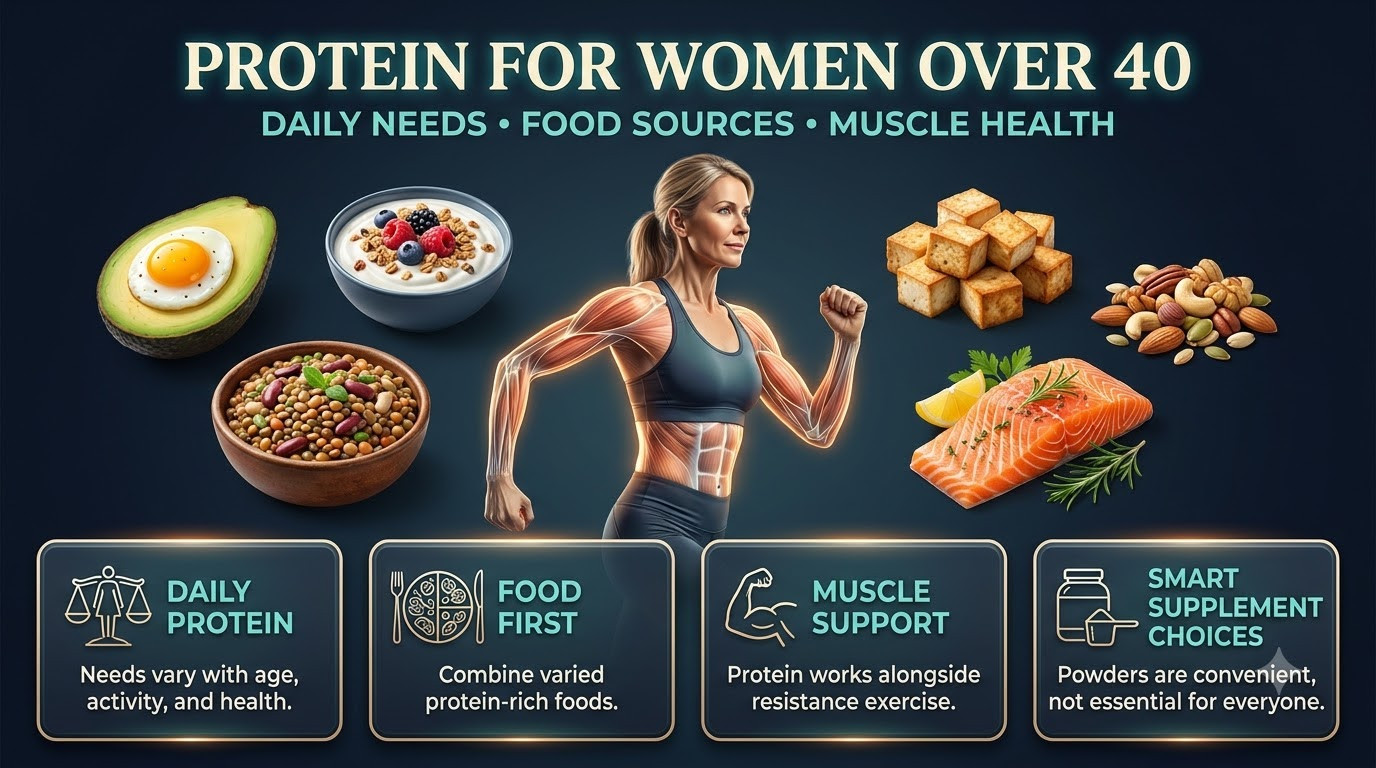
Protein becomes a central topic of conversation for women navigating their 40s and 50s. As women enter perimenopause and menopause, fluctuating estrogen levels, shifts in visceral adiposity, and a subtle decline in resting metabolic rate make muscle preservation essential for metabolic vitality, functional independence, and bone density.
However, nutritional guidance is often polarized: some fitness communities advocate extreme 1-gram-per-pound regimens, while standard public health guidelines still cite minimal baseline targets designed simply to prevent clinical deficiency. Modern nutritional physiology reveals that women over 40 benefit from higher per-meal protein quality to overcome anabolic resistance, without needing extreme restrictions or expensive supplements.
1. Why Protein Matters After 40: The Physiology of Anabolic Resistance
Starting around the fourth decade of life, human adults naturally lose approximately 3% to 8% of muscle mass per decade—a process known as sarcopenia. For women, this rate often accelerates during the perimenopausal transition due to declining 17β-estradiol concentrations. Estrogen plays a protective role in muscle stem cell (satellite cell) survival and regeneration, insulin sensitivity, and collagen synthesis in tendons.
Crucially, aging muscle develops anabolic resistance: a blunted sensitivity to the stimulatory effects of circulating amino acids and insulin on Muscle Protein Synthesis (MPS). Whereas a 20-year-old female might robustly initiate MPS with 15–20 grams of dietary protein, a woman over 40 requires a higher per-meal concentration (typically 25–35 grams) to activate the mammalian target of rapamycin complex 1 (mTORC1) pathway.
2. How Much Protein Do You Actually Need? (RDA vs. Optimal)
The established Recommended Dietary Allowance (RDA) of 0.8 grams per kilogram of body weight per day was established by the National Academies to prevent frank nitrogen deficiency in sedentary populations. It is not an optimal target for active aging or preserving lean tissue.
Calculating Daily Protein Targets:
- Baseline Deficiency Prevention (RDA): $0.8\text{ g/kg/day}$ (e.g., $65\text{ kg} \times 0.8 = 52\text{ grams/day}$)
- Active Aging & Lean Mass Preservation (PROT-AGE & ESPEN Consensus): $1.2\text{ to }1.6\text{ g/kg/day}$ (e.g., $65\text{ kg} \times 1.4 = 91\text{ grams/day}$)
- Resistance-Training Female Athletes: Up to $1.6\text{ to }2.0\text{ g/kg/day}$ during caloric restriction to spare lean muscle tissue.
Note: To convert body weight in pounds to kilograms, divide by 2.2.
3. Top Protein Sources & Leucine Content (Comparison Table)
The branched-chain amino acid leucine acts as the metabolic "ignition switch" for muscle protein synthesis. Reaching approximately 2.5 to 3.0 grams of leucine in a meal maximally stimulates the mTORC1 signaling cascade:
| Food Source | Standard Serving | Total Protein (g) | Leucine Content (g) | Nutrient & Satiety Highlights |
|---|---|---|---|---|
| Wild Salmon / Cod | 4 oz (113g) cooked | 26–28 g | ~2.2–2.5 g | Rich in EPA/DHA omega-3 fatty acids; supports joint and cardiovascular health. |
| Chicken / Turkey Breast | 4 oz (113g) cooked | 32–34 g | ~2.6–2.8 g | Highly bioavailable complete animal protein with low saturated fat. |
| Plain Greek Yogurt (0–2%) | 1 cup (227g) | 20–24 g | ~2.1–2.4 g | Supplies bone-building calcium, phosphorus, and gut-friendly probiotics. |
| Pasture-Raised Eggs | 3 large eggs | 18 g | ~1.6 g | Choline for cognitive/liver health, lutein, and fat-soluble vitamins A & D. |
| Firm Organic Tofu | 1 cup (250g) | 20 g | ~1.6 g | Complete plant protein containing beneficial soy isoflavones; lower leucine density. |
| Cooked Green Lentils | 1 cup (200g) | 18 g | ~1.3 g | Prebiotic fiber (15g), folate, and non-heme iron; requires larger portions for leucine trigger. |
4. Meal Distribution & The Leucine Trigger Concept
Many individuals consume an asymmetric protein pattern: a carb-heavy breakfast (toast or fruit, ~5g protein), a light lunch (salad, ~15g protein), and a massive dinner (steak or chicken, ~50g protein). This pattern only stimulates MPS once per day.
A more effective pattern for women over 40 distributes protein evenly across the day:
- Breakfast: 25–30g protein (e.g., 3 eggs with spinach and feta, or Greek yogurt with chia seeds).
- Lunch: 25–30g protein (e.g., 4 oz grilled chicken or tofu over a high-fiber quinoa bowl).
- Dinner: 30–35g protein (e.g., baked salmon with roasted broccoli and lentils).
5. Protein and Resistance Training Synergy
Nutritional protein provides the required substrates, but mechanical tension provides the biological stimulus. Consuming high protein without resistance exercise will not prevent sarcopenia or build bone density.
Progressive resistance training (utilizing free weights, resistance bands, cable machines, or bodyweight loading) at least 2 to 3 days per week stimulates muscle remodeling. Resistance exercise also sensitizes muscle tissue to amino acid uptake for up to 24 to 48 hours post-workout.
6. Protein Powders: When Are They Useful?
Protein powders are processed dietary foods, not hormonal enhancers or metabolic requirements. Whole foods should remain your foundation because they supply zinc, iron, selenium, B-vitamins, and fiber.
However, quality powders (e.g., pure whey isolate or pea-rice blends) offer significant practical advantages for women struggling to reach 90–100 grams daily due to busy work schedules or reduced appetite. Choose products verified by independent third-party testing (NSF Certified for Sport or Informed Choice) with zero unnecessary proprietary blends.
7. Common Dietary Mistakes to Avoid
- Mistake 1: Relying Exclusively on Nuts/Seeds for Protein: While almonds and chia seeds are nutrient-dense healthy fats, their protein-to-calorie ratio is relatively low (~6g protein per 160–200 calories). Relying solely on nuts to reach 90g of protein can substantially increase overall caloric intake.
- Mistake 2: Chronically Undereating Total Calories: When overall energy intake is severely restricted, the body oxidizes dietary and skeletal amino acids for gluconeogenesis rather than using them for tissue repair.
- Mistake 3: Fearing "Bulking": Due to female endocrine profiles, lifting weights and consuming adequate protein produces lean, firm neuromuscular tone, not bulky masculine muscle hypertrophy.
8. Safety: Renal Health and Medical Contraindications
- Healthy Kidneys vs. Pre-Existing CKD: Extensive meta-analyses confirm that higher protein intakes (up to 1.6–2.2 g/kg/day) do not impair renal filtration or induce glomerular damage in individuals with normal baseline kidney function.
- Chronic Kidney Disease (CKD): For women with diagnosed CKD (eGFR < 60 mL/min/1.73m²), protein filtration places additional hyperfiltration stress on damaged nephrons. Patients with non-dialysis CKD often require tailored protein restrictions (e.g., 0.6–0.8 g/kg/day) under renal dietitian oversight.
- Hydration Balance: Increased urea clearance requires adequate fluid intake. Ensure you drink sufficient fluids to maintain pale yellow urine throughout the day.
Frequently Asked Questions
1. How much protein does a woman over 40 need each day?
The general adult Recommended Dietary Allowance is 0.8 grams of protein per kilogram of body weight per day. Individual needs may differ with activity, overall health, energy intake, and medical circumstances. A healthcare professional or registered dietitian can help determine an appropriate target.
2. Can women over 40 get enough protein without eating meat?
Yes. Beans, lentils, chickpeas, soy foods, tofu, tempeh, dairy products, eggs, nuts, seeds, and whole grains can contribute protein. Eating a variety of plant foods across the day helps provide a broad range of essential amino acids and other nutrients.
3. Is protein powder necessary after age 40?
No. Protein powder is a convenience, not a requirement. Many people can meet their needs with meals and snacks. A supplement may be useful when food intake is insufficient or practical barriers make eating enough protein difficult, but individual health needs should be considered.
4. Does eating more protein automatically build muscle?
No. Muscle development depends on several factors, including resistance exercise, sufficient overall energy, recovery, sleep, and adequate nutrition. Protein provides building blocks, but simply increasing intake does not guarantee muscle growth.
5. Should women with kidney disease increase their protein intake?
Not without individualized medical advice. Some kidney conditions require protein intake to be adjusted according to disease stage, nutritional status, and treatment, while needs can differ for people receiving dialysis. A healthcare professional or renal dietitian should guide the decision.
📚 Sources and Further Reading
- National Academies of Sciences, Engineering, and Medicine. Dietary Reference Intakes for Energy, Carbohydrate, Fiber, Fat, Fatty Acids, Cholesterol, Protein, and Amino Acids. Consensus report on dietary amino acid requirements. Read NASEM DRI Report.
- PROT-AGE Study Group / Bauer J, et al. (JAMDA). Evidence-Based Recommendations for Optimal Dietary Protein Intake in Older Adults. Clinical consensus guidelines on 1.2–1.5 g/kg intake to counteract anabolic resistance. Read PROT-AGE Consensus Paper.
- Centers for Disease Control and Prevention (CDC). Physical Activity Guidelines for Adults. Muscle-strengthening activity recommendations for metabolic health and physical independence. Read CDC Guidelines.
- National Institute of Diabetes and Digestive and Kidney Diseases (NIDDK). Nutrition for Chronic Kidney Disease. Clinical management of dietary protein and glomerular filtration rate. Read NIDDK Kidney Health Guidelines.